
-
Certified Company
ISO 9001:2015 -
30+ Years
of Filtration Excellence
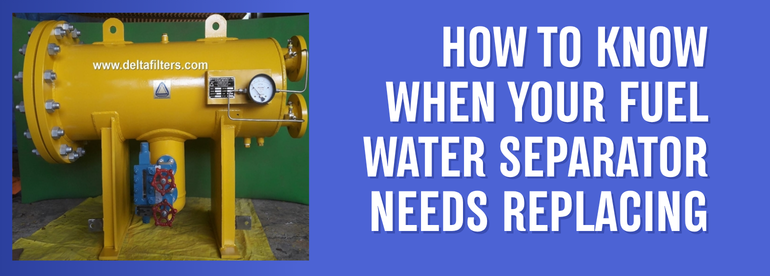
How to Know When Your Fuel Water Separator Needs Replacing
Fuel water separators don’t usually fail all at once. They wear down slowly, and by the time the problem becomes obvious, water has often already made its way into fuel lines, storage tanks, or an engine.
If you handle diesel, petrol, kerosene, or bio-diesel in any volume, knowing what to look for on your separator can save you from a much bigger repair bill later.
What the Separator Is Actually Doing
A fuel-water separator works on a fairly simple principle. Fuel passes through a coalescing element, which pulls tiny, scattered water droplets together into bigger drops. Once they’re heavy enough, gravity does the rest, and the water settles at the bottom of the vessel where it can be drained off.
A separator in good condition can bring free water content down to around 15 ppm, which is generally treated as the benchmark for clean diesel in engines, generators, and terminal operations.
That performance depends entirely on the condition of the coalescing element and separator media inside. Once that media starts to wear out or clog, the unit stops doing its job properly, no matter how good it looked when it was installed.
Signs Your Separator Is on Its Way Out
1. Water keeps coming back faster than it used to
Most units have a sight glass or water level gauge for a reason. If you’re draining water more often than before, or the level climbs back up quickly after each drain, something inside has changed. That’s usually the coalescing element losing its grip.
2. Pressure drop across the unit keeps creeping up
As the filter element loads with contaminants, it gets harder for fuel to pass through, and your pressure gauge will show it. A reading that keeps rising past what the manufacturer recommends is one of the clearest indicators that a replacement is due.
3. Fuel tests keep coming back with water content above the target
If you’re running regular fuel samples or you’ve got in-line moisture sensors, and the numbers stay above the accepted limit even though the separator “looks fine,” the internal media has probably reached the end of its useful life.
4. You can see damage on the vessel itself
Corrosion around welds, hairline cracks, leaking fittings, a drain valve that won’t seal properly – none of this should be brushed off. It doesn’t matter how well the internal element is performing if the housing itself is compromised.
5. Downstream equipment starts acting up.a
Injector trouble, unexplained corrosion in fuel lines, and engines or generators not running the way they should are often the first real signs that water has been getting past the separator for a while.
6. The unit is simply past its service life
Every separator has an expected working life based on flow rate, fuel type, and how it’s being used. If maintenance logs show it’s overdue, it’s worth checking even if nothing looks obviously wrong. Waiting for a visible failure usually means the unit has already been underperforming for some time.
A Reasonable Inspection Routine
There’s no single schedule that fits every operation, but a few habits go a long way:
- Check the water level and drain valve regularly, especially at high-throughput sites like fuel terminals.
- Log pressure drop readings at set intervals so you can spot a trend before it becomes a problem.
- Run fuel sample tests periodically, particularly for diesel generators, marine systems, and refinery operations where fuel quality really matters.
- Take a close look at the vessel and fittings during routine maintenance for early corrosion or wear.
- Stick to the replacement interval recommended for your particular separator model and flow rate.
Why It’s Not Worth Putting Off
Pushing back a replacement rarely saves money once you add up the downstream costs. Water sitting in storage tanks encourages microbial growth. It corrodes pipelines and fuel lines. It cuts combustion efficiency and wears out injectors and pumps faster than they should.
And if you’re loading or unloading fuel at a terminal, contaminated fuel can also put you on the wrong side of quality standards. In almost every case, a planned replacement costs less time and money than an unplanned shutdown caused by water in the fuel.
Delta Filters & Separators Pvt Ltd: Your Trusted Destination for Separators
Delta Filters & Separators Pvt Ltd has been manufacturing filtration and separation equipment in India since 1994, and the company is ISO 9001:2015-certified. Its Fuel Water Separators are used in fuel transportation and in loading and unloading operations at terminals, refineries, and marine sites, with two-stage coalescer designs built to bring free water content down to roughly 15 ppm.
The equipment is designed and tested to ASME Codes and ASNT-approved procedures, and Delta’s Fuel Water Separators have gone through third-party inspection with agencies such as the American Bureau of Shipping (ABS) and the Indian Register of Shipping (IRS).
Delta Filters isn’t limited to fuel-water separation either. It’s also counted among the established demister pad manufacturers in India, producing wire mesh and vane-type demister pads that are used for mist elimination in gas conditioning skids, moisture separators, and knock-out drums.
A quick look at where the company stands
- Over 200 projects delivered under third-party inspection from agencies including SGS, Bureau Veritas, TUV-NORD, TUV-SUD, DNV, ABS, Germanischer Lloyd, and IRS.
- Equipment supplied to customers in more than 50 countries across Europe, Asia, Africa, the Middle East, and the Americas.
- A manufacturing facility in Khalapur, Maharashtra, backed by a well-established supply chain of raw material sources and service partners.
- A product line that covers Fuel Water Separators, Natural Gas Filters, CNG Filters, Duplex Gas Filters, Fuel Gas Coalescers, Gas Conditioning Skids, Compressed Air Filters, Moisture Separators, Strainers, and Demister Pads.
- A name that comes up often among reliable demister pad suppliers and separator equipment providers for industries like oil & gas, refining, power generation, pharmaceuticals, and food processing.
If you’re due for a fuel-water separator replacement, or you’re sourcing demister pads for a mist elimination system, Delta Filters builds equipment to standards that hold up across these kinds of demanding applications.
Final Thoughts
A fuel-water separator is a small component with an outsized job. Its condition affects fuel quality, equipment life, and, in some cases, whether you’re meeting the standards your operation is held to.
Keep an eye on water levels, pressure drop, fuel test results, physical condition, and how downstream equipment is performing, and you’ll rarely be caught off guard by a failed unit. Working with a manufacturer that has real experience in both replacement units and ongoing servicing makes that job a lot easier.