
-
Certified Company
ISO 9001:2015 -
30+ Years
of Filtration Excellence
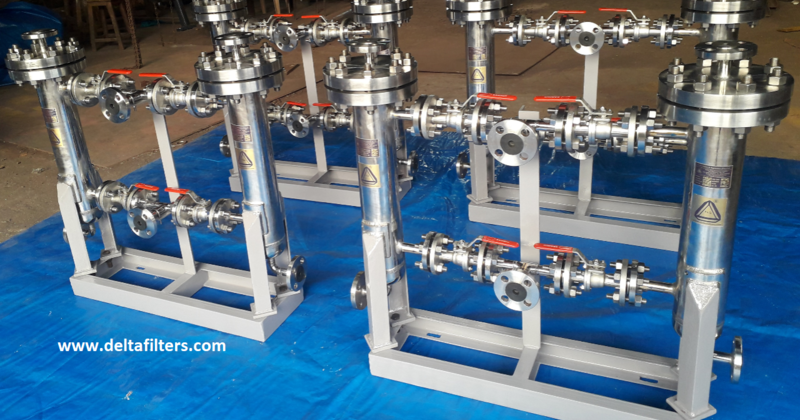
Duplex Strainers vs. Simplex Strainers: Do You Really Need Zero Downtime?
Unplanned downtime carries a direct cost to production output, equipment reliability, and maintenance budgets. Strainers are a small component in the overall pipeline, yet the configuration selected determines whether routine basket cleaning requires a full process shutdown or can be carried out without interrupting flow.
This guide examines the functional difference between duplex and simplex strainers and outlines the criteria to consider when selecting the right configuration for your process.
What Is a Simplex Strainer?
A simplex strainer is a single-basket unit. It is one housing, one basket, and one flow path. Delta Filters manufactures simplex-style units in Y-type, Tee-type, and Basket-type configurations, each suited to different pipe layout and space constraints.
Basket-type strainers, for example, offer a larger filtration area than Y-type or Tee-type designs. That means more surface area for solids to collect on before the pressure drop climbs too high.
They come in:
- Mesh ratings from 10 to 400 mesh
- Housing materials such as SA 516 Gr. 70, SA 106 Gr. B, SS304, or SS316(L)
- Basket materials in SS304, SS316, or SS316L
- Line sizes from 2″ NB to 12″ NB
- Flanged ends from Class 150 up to Class 900 for higher-pressure duty
The trade-off is simple. To clean or replace the basket, you have to isolate the line and stop the flow. There is no second flow path to fall back on.
What Is a Duplex Strainer?
A duplex strainer solves that exact problem. Delta Filters builds duplex strainers with two strainer housings arranged in parallel, connected by interconnecting piping and isolation valves.
Here is how it works in practice:
- One strainer stays in operation while the other is opened for servicing.
- Isolation valves let you switch flow from one basket to the other in seconds.
- The line never has to stop for a basket cleaning or replacement.
- Delta rates its duplex strainers for 100% availability during element servicing.
Delta duplex strainers use the same basket specification range as the simplex line, from 10 mesh to 400 mesh, in SS304 with SS316 or SS316L options. Construction follows ASME-qualified welding practices, and every unit is built under Delta’s ISO 9001:2015 quality system at its fabrication shop.
Duplex vs. Simplex: The Core Difference
| Factor | Simplex Strainer | Duplex Strainer |
| Number of baskets | One | Two, in parallel |
| Cleaning requires a line stop. | Yes | No |
| Isolation valve | Not applicable | Yes, built into the skid |
| Upfront cost | Higher | Lower |
| Footprint | Smaller | Higher |
| Best fit | Batch processes, redundant lines, non-critical service | Continuous processes where flow cannot stop |
The choice really comes down to one question: can your process tolerate a stop while someone cleans a basket?
Do You Really Need Zero Downtime?
Not every application needs a duplex strainer. Zero downtime sounds appealing, but it adds cost, weight, and complexity that some plants simply do not need. Ask these questions before you decide.
You likely need a duplex strainer if:
- Your process runs 24/7 with no built-in shutdown window.
- Stopping flow risks damage to a compressor, pump, or turbine.
- The line feeds a critical safety or export system.
- Cleaning frequency is high due to heavy solids loading.
- A shutdown costs more in lost production than the strainer’s extra price.
A simplex strainer is usually enough if:
- The plant already has planned maintenance windows.
- The line already has a parallel or standby unit elsewhere in the system.
- Solids loading is low, so cleaning is infrequent.
- Budget and space are tight, and the process can pause briefly.
- The application is a batch process rather than continuous flow.
There’s no universal right answer here. A refinery feed line and a small utility water line have very different tolerances for interruption, even though both might use a basket strainer somewhere in the process.
Where This Fits Into Your Broader Filtration Setup
Strainers protect downstream equipment from solid debris, but they are only one piece of a clean process stream. In compressed air systems, moisture and oil aerosols cause just as much damage as grit and rust particles, and they need a different type of equipment entirely.
1. Moisture Separator for Air Compressor Lines
It removes water vapor that condenses once air is compressed. Delta’s moisture separators use a coalescing element paired with an anti-re-entrainment barrier, removing up to 99.95% of moisture before it reaches pneumatic tools, instruments, or downstream machinery. They are typically installed right after the after-cooler, or ahead of an air dryer to cut its load.
2. Compressed Air Filters
Compressed air filters go a step further, removing fine particulate and oil aerosols down to 0.01 micron with residual oil content as low as 0.01 mg/m³. These filters use pleated borosilicate glass fiber elements and work through direct interception, inertial impaction, and coalescing action.
For plants running jet looms, powder coating lines, or oil-lubricated compressors, this level of filtration is often the difference between reliable output and constant equipment wear.
Just like the duplex-versus-simplex decision, the right combination of strainers, moisture separators, and compressed air filters depends on how much interruption your process can absorb, and how sensitive your downstream equipment is to contamination.
FAQs (Frequently Asked Questions)
- Can a duplex strainer really run with zero downtime?
Yes, because the two baskets share interconnecting piping with isolation valves, flow can be diverted to the standby basket while the other is cleaned, so the line keeps running.
- Is a duplex strainer always the better choice?
Not necessarily. It costs more, takes up more space, and adds valves that need periodic maintenance of their own. Continuous, critical-service lines benefit most; intermittent or low-solids lines rarely need it.
- What mesh sizes are available for duplex and simplex strainers?
Delta Filters offers both types from 10 mesh to 400 mesh, with baskets in SS304, SS316, or SS316L to match the process fluid.
- Do compressed air lines need strainers as well as moisture separators?
Often, yes. Strainers catch solid debris like scale and rust, while a moisture separator for air compressor systems removes condensed water, and compressed air filters handle fine particulate and oil aerosols. Each addresses a different contaminant.
Final Word
Duplex strainers earn their keep when a shutdown is simply not an option. Simplex strainers still make sense for the majority of applications where a short, planned cleaning cycle fits into the existing maintenance routine. The right call depends on your process criticality, your solids loading, and your tolerance for a stopped line.
Delta Filters has manufactured strainers, moisture separators, and compressed air filters since 1994, with installations across more than 50 countries.
If you’re not sure which configuration fits your line, reach out to the team at sales@deltafilters.com for guidance suited to your exact flow, pressure, and process conditions.