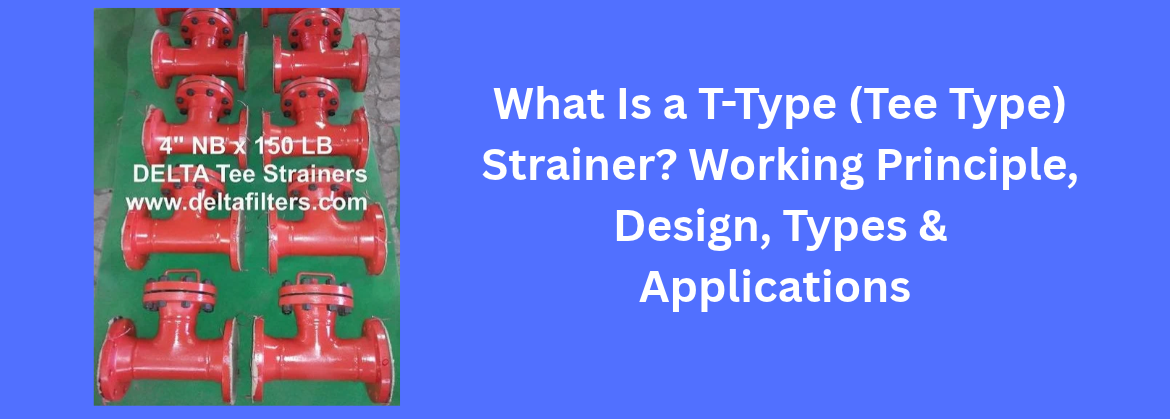
What Is a T-Type (Tee Type) Strainer? Working Principle, Design, Types & Applications
Industrial pipelines rarely carry a perfectly clean fluid. Scale, rust, weld debris, and other solid particles can enter the line during fabrication, installation, or normal operation. If these particles reach pumps, valves, or boilers, they can cause wear, blockages, and unplanned downtime.
Strainers are installed to prevent this. They allow the fluids to pass while holding back solid matter, which protects the equipment downstream. Among the available designs, the
T-type strainer, also known as the tee-type strainer, is widely chosen for its compact form.
This guide explains how it works, how it is built, where it is used, and what to consider when selecting one.
What Is a T-Type Strainer?
A tee strainer is a device that fluid passes through, and solid matter is removed as it does. Its job is to keep solid contaminants out of a liquid stream or flowline.
Tee strainers are made to remove foreign particles from the pipeline. They are a low-cost answer when the line size is large, and the nominal bore is big.
How a Tee Strainer Works
The working idea is simple. Liquid enters the strainer and moves through a basket. The basket has openings of a set size. Clean liquid goes downstream, and particles too large for the openings stay behind.
Delta Filters designs the flow path so nothing blocks it. This keeps the pressure drop low compared with other strainer types.
Tee strainers are usually supplied with a range of graded filtration levels. That lets the buyer pick the level that matches the job and makes sure clean liquid reaches the next stage.
Why Buyers Choose This Design
The tee strainer has a few practical strengths:
- Compact size: It does not need a large area to install. It suits places where space is tight.
- Low pressure drop: The open flow path helps the liquid move through with little loss.
- Flexible orientation: It can be installed vertically or horizontally.
- Equipment protection: It shields pumps, valves, boilers, and similar equipment from foreign matter.
- Low cost for large bores: It is an affordable option when the line size is big.
Types of Tee Strainers: Horizontal and Vertical
Delta Filters supplies tee strainers in two configurations:
- Horizontal: Fitted along a horizontal run of pipe.
- Vertical: Fitted on a vertical run.
The choice depends on how your piping is laid out. Delta T Type Strainers are custom fabricated, so they can be built around your line.
Design and Construction
The Delta Tee Strainer is typically made of carbon steel or stainless steel. Optional materials, end connections, and accessories are also available.
These are the specifications of the T Strainer:
- End connections: Flanged (150 LB through 600 LB) or butt weld
- Body material: Carbon steel (A234) or stainless steel 304, 316 and 316L
- Basket material: SS304, SS316 and SS316L
- Mesh rating: 7 mesh to 1250 mesh
The strainers can handle these conditions:
- Viscosity: 0.1 CP through 1000 CP
- Operating temperature: Up to 200°C
Understanding Mesh Rating
Tee strainers are usually rated in U.S. mesh, not microns. Mesh tells you how many wires or threads run through one linear inch. It does not measure the hole size directly. As the number of wires per inch goes up, the micron rating goes down.
Here is a short sample from Delta’s table. Delta notes that these are rough values. For an exact match, the wire diameter must also be counted.
| U.S. Mesh |
Microns |
| 10 |
2000 |
| 50 |
297 |
| 100 |
149 |
| 200 |
74 |
| 400 |
37 |
| 1250 |
10 |
A low mesh number means a coarse screen. A high number means a fine one.
Where Tee Strainers Are Used
Tee strainers protect downstream equipment such as pumps, valves, and boilers. The fluids listed by Delta Filters for its tee strainers are:
Delta Filters supplies to Oil & Gas, Nuclear, Refinery, Aviation, Defence, Steel, Cement and Pharmaceutical industries.
FAQs (Frequently Asked Questions)
- What sizes do Delta tee strainers come in?
Delta lists line sizes from 2″ to 48″ for its T-type strainers. Because these strainers are custom-fabricated, the size can be matched to your pipeline.
- What are the body and basket materials?
The body comes in carbon steel (A234) or stainless steel 304, 316, and 316L. The basket comes in SS304, 316, and 316L. Optional materials are also available.
- Can a tee strainer be installed vertically?
Yes. Delta tee strainers work in both vertical and horizontal installations. They are also compact, so they suit places where space is limited.
- What mesh ratings are available?
Delta offers mesh ratings from 7 mesh to 1250 mesh. A higher mesh number gives finer filtration, and the right choice depends on the particle size you need to stop.
- Where does Delta Filters supply?
Delta products have been commissioned in over 50 countries. These span Europe, Asia, Africa, the Middle East and the Americas.
- Is Delta Filters certified?
Delta Filters is an ISO 9001:2015 certified company. It designs, manufactures, and tests its products per the latest ASME Codes and ASNT-approved procedures.
Delta Filters: Working Principle, Design, Types & Applications
Delta Filters was established in 1994 and has over 30 years of engineering experience in filtration and separation. The company manufactures filters, separators, and strainers at its Khalapur, Maharashtra, facility. Every product is designed, manufactured, and tested as per the latest ASME Codes and ASNT-approved procedures.
Here is a quick look at the company’s record:
- Certification: ISO 9001:2015.
- Projects: Over 200 executed under third-party inspection agencies.
- Inspection agencies: SGS, Bureau Veritas, TUV-NORD, TUV-SUD, DNV, ABS, Germanischer Lloyd and IRS.
- Reach: Customers in over 50 countries across Europe, Asia, Africa, the Middle East and the Americas.
- Markets served: Oil & Gas, Nuclear, Refinery, Aviation, Defence, Steel, Cement and Pharmaceutical.
Summary
A tee-type strainer removes solid particles from a flowing liquid before they reach costly equipment. It is compact and works in vertical or horizontal lines. Its open flow path keeps pressure drop low.
Delta Filters builds custom tee strainers with these options:
- Line sizes from 2’’ to 48’’
- Carbon steel or stainless steel bodies
- Mesh ratings from 7 to 1250
Picking the right one comes down to your fluid, line size, viscosity, temperature, and the filtration level you need.