
-
Certified Company
ISO 9001:2015 -
30+ Years
of Filtration Excellence
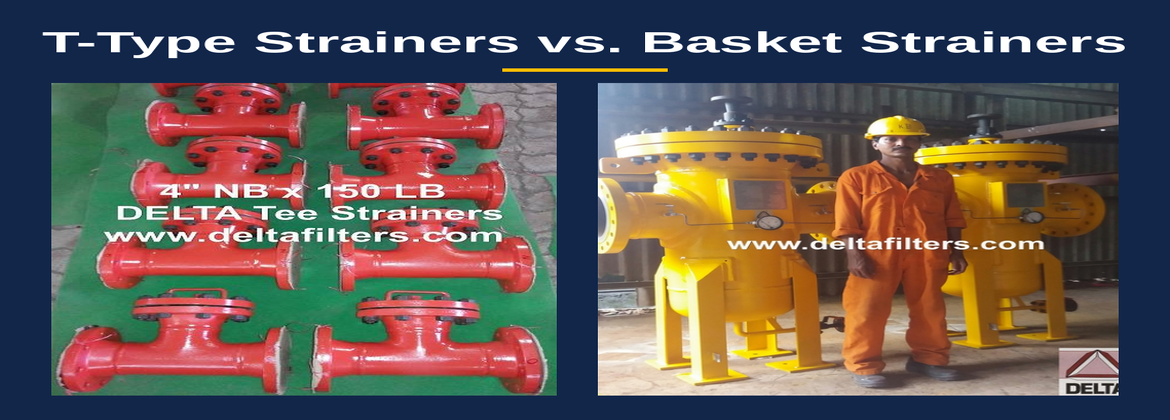
T-Type Strainers vs. Basket Strainers
Every process plant runs on fluids moving through pipes. Water, seawater, lube oil, chemicals, and fuel travel from tanks to pumps, valves, and boilers every day. Along the way, they pick up rust flakes, weld slag, scale, and other loose solids. If that debris reaches a pump or a valve seat, it can lead to wear, leaks, and unplanned shutdowns.
This is why strainers sit in so many pipelines. They are simple devices, but the wrong choice can cost you flow, space, or maintenance. Two common options are the T-type (tee) strainer and the basket strainer.
Both do the same basic job, just in different ways. Below, we compare their design, performance, and uses so you can match the right strainer to your line.
What Does a Strainer Do?
A strainer is a device that a fluid passes through so that solid matter can be removed. It holds back solid contaminants and keeps them out of the flow line. Clean fluid then moves on to the equipment downstream.
Both T-type and basket strainers use mesh to trap particles. The real difference lies in body shape, the flow path, and how much screen area each one offers.
What Is a T-Type Strainer?
A T-type strainer has a tee-shaped body. Delta Filters custom fabricates its tee strainers and supplies them in both horizontal and vertical configurations. The design gives the fluid an open, unrestricted path. The result is a low pressure drop compared to other strainer types.
Tee strainers are a low-cost answer for large nominal bore lines. They need very little room, so they suit plants where space is tight. They are commonly supplied with graded filtration levels to make sure clean liquid flows downstream. They protect equipment such as boilers, pumps, and valves.
Delta T-Type Strainer Specifications
Housing material: Carbon steel (A234), SS304, SS316 and SS316L
Basket material: SS304, SS316, SS316L and Monel 400
Mesh rating: 7 mesh to 1250 mesh
End connections: Flanged or butt weld
Fluids handled: Water, seawater, chemicals, lubricating oil, LSHS, and natural gas
Viscosity range: 0.1 cP to 1000 cP (centipoise, a measure of how thick a fluid is)
Operating temperature: Up to 200°C
Optional materials, end connections, and accessories are also available.
What Is a Basket Strainer?
A basket strainer traps solid contaminants from liquid streams. It uses a mesh-type basket fitted inside an outer strainer housing, which is how it gets its name.
Its biggest strength is its filtration area. A basket strainer offers a much higher filtration area than both Y-type and tee-type strainers. It is placed upstream of pumps, valves, and other process equipment. This helps protect costly equipment from damage and downtime.
Delta Basket Strainer Specifications
Housing material: SA 516 Gr. 70, SA 106 Gr. B, SS304 and SS316 (L)
Basket material: SS304, SS316 and SS316L
Line size: 2″ NB to 12″ NB
End connections: Flanged, from 150 Class to 900 Class for higher operating pressure
Mesh rating: 10 mesh to 400 mesh
T-Type vs. Basket Strainers: Key Differences
Design and Footprint
The tee strainer is compact. It works in vertical or horizontal lines and fits where there is little room around the pipe. The basket strainer, on the other hand, places a mesh basket inside a separate housing. Its design is built around screen area rather than a tight footprint.
Flow and Pressure Drop
The tee strainer’s open flow path keeps pressure drop low compared to other strainer types. If pressure loss across the line is a concern, this is a strong point in its favour.
Filtration Area
Here, the basket strainer leads. It provides much more filtration area than a tee-type unit.
At a Glance
Shape: Tee-shaped body vs. basket inside an outer housing
Mounting: Vertical or horizontal (T-type) vs. upstream of pumps and valves (basket)
Pressure drop: Low (T-type)
Filtration area: Much higher (basket)
Mesh range: 7-1250 mesh (T-type) vs. 10-400 mesh (basket)
Line size: Large nominal bore lines (T-type) vs. 2″ NB to 12″ NB (basket)
How to Read Mesh Ratings
Strainer ratings are most often given in U.S. mesh, not microns. Mesh refers to the number of openings per linear inch using standard wire diameters. As the mesh number goes up, the opening size goes down.
Here are a few rough values:
- 10 mesh = about 2000 microns
- 40 mesh = about 420 microns
- 100 mesh = about 149 microns
- 400 mesh = about 37 microns
- 1250 mesh = about 10 microns
These figures are a guide. For an exact match, the wire diameter must also be part of the calculation.
Which Strainer Should You Choose?
The answer depends on your line, your space, and the level of protection you need.
A T-type strainer makes sense when:
- Space around the pipeline is limited
- The line has a large nominal bore and cost matters
- Low pressure drop is a priority
- You need vertical or horizontal mounting
- You need very fine straining, up to 1250 mesh
A basket strainer makes sense when:
- You want maximum filtration area in a liquid line
- Your line size sits between 2″ NB and 12″ NB
- Higher operating pressure needs flange classes up to 900
- You want to shield costly pumps and valves from damage and downtime
-
How Delta Filters Builds and Tests Its Strainer
Delta Filters was founded in 1994 and brings more than 30 years of experience in filtration and separation. It is an ISO 9001:2015 certified company. Its strainers are made at the Delta Filters Works in Khalapur, Maharashtra. The team designs, makes, and tests filters, separators, and strainers as per the latest ASME codes and ASNT-approved procedures.
Quality checks on the shop floor include:
Welding by qualified welders as per ASME Sec. IX and approved WPS/PQR
Dye penetrant testing on every weld joint
100% radiography of butt welds by an ASNT-qualified inspector
UT/MPT of fillet welds based on QAP needs
Hydrostatic and pneumatic testing of pressure vessels
Delta Filters has completed over 200 projects under third-party inspection agencies such as SGS, Bureau Veritas, TUV-NORD, TUV-SUD, DNV, ABS, Germanischer Lloyd and IRS.
FAQs (Frequently Asked Questions)
- Which strainer is more compact?
The T-type strainer is more compact. It needs very little room and suits lines where space is restricted.
- Which strainer gives more filtration area?
The basket strainer gives more filtration area. It offers much more filtration area than Y-type and T-type designs.
- What materials does Delta Filters use?
Tee strainer housings come in carbon steel (A234) and SS304/316/316L. Basket strainer housings come in SA 516 Gr. 70, SA 106 Gr. B and SS304/316(L). Strainer baskets are made in SS304, SS316, and SS316L, with Monel 400 also on offer for tee strainers.
- Where has Delta Filters supplied its products?
To customers in over 50 countries across Europe, Asia, Africa, the Middle East, and the Americas.
- Which industries does Delta Filters serve?
Delta Filters serves industries such as oil and gas, nuclear, refinery, aviation, defence, steel, cement, and pharmaceuticals.
Summary
T-type and basket both keep solids out of your pipeline, but each has its own strengths. The T-type strainer is compact, cost-effective for large-bore lines, and keeps pressure drop low.
The basket strainer offers far more filtration area and protects pumps and valves in liquid lines from 2″ NB to 12’’ NB. The right pick comes down to space, line size, pressure, and the level of filtration your process needs.
Need help choosing the right strainer?
Contact Delta Filters & Separators Pvt. Ltd. at sales@deltafilters.com or call +91 9930073977 / +91 22-27752357. Corporate Office: B-101 Sanpada Station Complex, Sanpada, Navi Mumbai 400705, India.
Read Also: What Is a T-Type (Tee Type) Strainer? Working Principle, Design, Types & Applications