
-
Certified Company
ISO 9001:2015 -
30+ Years
of Filtration Excellence
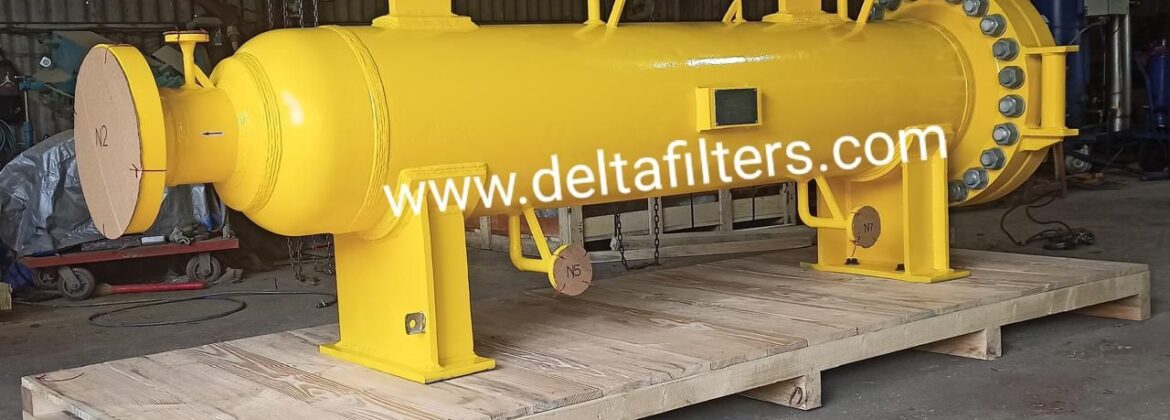
10 Types of Industrial Filters, Separators, and Strainers and Where They Are Used
Every plant runs on things moving through pipes: gas, air, fuel, and liquids. Almost all of them pick up something unwanted on the way. Natural gas can collect rust, dust, and oil between the well and the burner. Air leaving a compressor carries water and oil. Diesel can carry water into a tank.
That dirt wears out pumps, clogs valves, and stops production. Filters, separators, and strainers are how plants deal with it. They can look alike from the outside, but each does a different job.
This guide covers ten types, what each removes, and where it is used. The product details come from Delta Filters & Separates Pvt Ltd, an Indian manufacturer set up in 1994.
What is the Difference Between a Filter, a Separator, and a Strainer?
- Filter: Removes solid particles from gas or air. Coalescing types also catch fine liquid droplets.
- Separator: Pulls out water, oil, or moisture.
- Strainer: Catches solids in a pipeline using a mesh or perforated element.
The 10 Types and Where They Are Used
- Natural Gas Filters
Gas picks up rust, dust, oil, and condensates during drilling, compression, and transmission. These filters remove them. Delta builds ASME-coded vessels for pressures up to 300 Bar, in dry gas and coalescing versions.
- Used in city gas distribution, metering skids, and MRS and DRS stations.
- Also used with gas engines, gas turbines, and petrochemical plants.
- CNG Filters
Compressed natural gas collects solids, moisture, and compressor oil before it reaches a vehicle. Delta’s CNG filters remove particles down to 0.01 micron and oil down to 0.01 ppm.
- Fitted in booster and online compressors, dispensers, LCV filling posts and decompression skids.
- OEM customers are in India, the UAE, South America, Indonesia, North America, Southeast Asia and Turkey.
- Duplex Gas Filters
Two full-capacity filters sit in parallel. One works while the other stands by. When one comes off for service, the second takes over, so gas keeps flowing. Both can also run together for 200% flow.
- Feeds gas engines and gas turbines
- Suited to power generation, steel plants, and refineries
- Fuel Gas Coalescers
Tiny drops of oil and water merge into bigger ones and fall into a sump. The liquid leaves through a manual or automatic drain. Delta rates them for liquid particles of about 0.5 micron, at up to 99.9% efficiency.
- Placed before a compressor to stop liquid slugs
- Placed after a compressor to recover lube oil
- Used in oil and gas, petrochemical, and refining
- Compressed Air Filters
Air from a screw or piston compressor carries water, oil, dust, and rust. Delta’s filters remove solids down to 0.01 micron at 99.99% efficiency, with residual oil of 0.01 mg/m³. Delta guarantees 10,000 working hours of element life.
- Types include particulate, activated carbon, coalescing, and cold coalescing.
- Used for jet looms, power tools, blasting, painting and powder coating.
- Also used for air feed to oxygen plants in the steel industry.
- Moisture Separators
Compressing air makes water vapour condense. A coalescing element makes the droplets heavy, and gravity drops them into the sump. Delta states that its separator removes 99.95% of moisture. It was introduced in 1994 and has over 10,000 installations in India and over 25 countries.
- Fit close to the point of use, or right after the after-cooler.
- Fit before air dryers to reduce their load.
- Handle flows from 30 scfm to 50,000 scfm.
- Fuel Water Separators
These two-stage units remove solids and water from diesel, petrol, kerosene, and biodiesel. Delta says they bring water content down to 15 ppm.
- Used at refineries, fuel terminals, and in tanker loading and unloading.
- Also used in marine service and with diesel generators.
- Third-party inspection was carried out by ABS and IRS.
- Y Type Strainers
A compact strainer with a wire mesh or perforated element. It shields meters, pumps, regulators, and control valves. It suits lines where solids are few and cleaning is rare, and it can be installed horizontally or vertically.
- Line sizes from 4 to 40 inches, mesh from 7 to 1250, temperatures up to 200°C
- Handles water, seawater, chemicals, lube oil, and natural gas
- Used in refineries and power plants
- Basket Type Strainers
A mesh basket sits inside an outer housing. That gives far more filtering area than Y or Tee types. Installed ahead of pumps, valves, and other process equipment, they trap solids in liquid lines.
- Sizes from 2 to 12 inch NB, mesh from 10 to 400
- Flanges from 150 to 900 class for higher pressure
- Vacuum Pump Exhaust Mist Filters
Oil-sealed vacuum pumps release oil fumes from the exhaust, especially at start-up. A coalescing element turns that mist into liquid oil. Delta lists 99.5% oil mist removal.
- Separated oil can be drained and reused
- Gives a cleaner, smoke-free work area
FAQs (Frequently Asked Questions)
- Which industries does Delta Filters serve?
Delta serves oil and gas, nuclear, refinery, aviation, defence, steel, cement and pharmaceutical customers.
- Which countries has Delta supplied?
Delta has supplied customers in over 50 countries across Europe, Asia, Africa, the Middle East and the Americas.
- How is the equipment made and tested?
- ISO 9001:2015 certified, with a facility in Khalapur, Maharashtra
- Housings designed to ASME Sec VIII Div 1
- Welding follows ASME Sec IX, and testing follows ASME Sec V
- 100% hydro testing before dispatch
- Over 200 projects inspected by third parties such as SGS, Bureau Veritas, TUV-NORD, TUV-SUD, DNV, ABS, Germanischer Lloyd and IRS
- What should I tell a supplier before ordering?
Have these ready: gas or fluid flow rate, operating pressure, operating temperature, line size, filtration efficiency, contaminant type, and connection standard.
Summary
Filters clean gas and air. Separators remove water and oil. Strainers protect pipelines from solids. The right choice depends on what is in your stream, your pressure and flow, and how much downtime you can accept. Where a line cannot stop, duplex designs let one unit run while the other is serviced.
To discuss your application, email sales@deltafilters.com or call +91 9930073977 or +91 22-27752357. Office: B-101 Sanpada Station Complex, Sanpada, Navi Mumbai 400705, India.
Read Also: Duplex Strainers vs. Simplex Strainers: Do You Really Need Zero Downtime?