
-
Certified Company
ISO 9001:2015 -
30+ Years
of Filtration Excellence
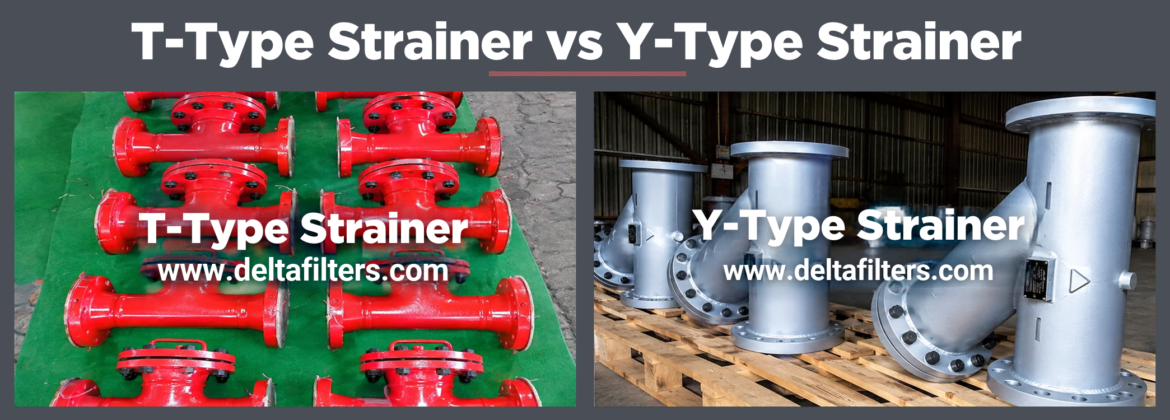
T-Type Strainer vs Y-Type Strainer
Industrial pipelines rarely carry a perfectly clean fluid. Solid particles can travel with the flow, and when they reach pumps, meters, or control valves, they can cause wear, damage, and unplanned repairs. Protecting this equipment is a basic part of sound piping design.
A strainer is the component that handles this job. It sits in the line, lets the fluid pass, and holds back solid matter before it can reach sensitive equipment downstream. Engineers and procurement teams often compare two designs: the T-type, also known as the Tee type, and the Y-type.
Both serve the same purpose, yet they differ in construction, line size range, and the conditions they suit best. This post compares them on design, flow, and maintenance, so you can see which one fits your line.
What Is a Y-type strainer?
A Y-type strainer removes unwanted solids from liquid, gas, or steam lines. It uses a perforated plate or a wire mesh element to do it. The compact body is its main selling point. It fits where a space is tight and a sturdy unit is needed.
The Delta Filters Y strainer uses an SS304 element. That element is a cylindrical wire mesh welded onto a perforated plate. It can be installed horizontally or vertically, and it protects equipment such as meters, pumps, regulators, and control valves.
Delta Filters lists these specifications for its Y strainers:
- Line size: 4’’ to 40’’
- End connections: Flanged, 150 LB through 600 LB
- Body material: Carbon steel (A106 Gr. B) or stainless steel 304/316/316L
- Basket material: SS304, 316, or 316L
- Mesh rating: 7 mesh to 1250 mesh
What Is a T-Type Strainer?
A T-type strainer is also known as a Tee strainer. Delta Filters describes its Tee strainers as custom fabricated. They are offered in horizontal and vertical configurations, and the company calls them a low-cost answer to large nominal bore straining needs.
They protect downstream equipment like pumps, valves, and boilers. Delta Filters also notes that Tee strainers are commonly supplied with a range of graded filtration levels, so clean liquid flows downstream.
Here are the published specifications for the Delta Filters Tee strainer:
- Line size: 2″ to 48″
- End connections: Flanged, 150 LB through 600 LB, or butt weld
- Body material: Carbon steel (A234) or stainless steel 304/316/316L
- Basket material: SS304, 316, or 316L
- Mesh rating: 7 mesh to 1250 mesh
T-Type vs Y-Type: The Key Differences
- Design
The Y strainer is the compact, sturdy option. Delta Filters points to space-limited installations as its sweet spot. The Tee strainer is also described as compact, but it is the one built for larger lines. Its size range runs up to 48″, while the Y strainer stops at 40″. The Tee strainer also offers a butt weld end connection. The Y strainer is listed with flanged ends.
- Flow
Delta Filters says the Tee strainer design gives the fluid an unrestricted flow path. The result is a low pressure drop compared with other strainer types. For the Y strainer, the focus is on the fluids it handles. It works on liquid, gas, and steam lines.
Both designs are listed for the same fluids and operating limits:
- Water, sea water, chemicals, lubricating oil, LSHS, and natural gas
- Viscosity from 0.1 CP through 1000 CP
- Operating temperature up to 200°C
- Maintenance
Y strainers are generally chosen when the amount of solids is small. In those lines, frequent clean-out is not needed. That is a useful test for your own system. If you expect a light solids load, the Y type fits the job. If you are unsure how much debris your line will carry, talk it through with an engineer before you order.
Mesh rating is the other choice that affects how a strainer performs. The next section explains how to read it.
How to Read Mesh Ratings
Both strainer types are rated in U.S. mesh, not microns. Mesh is the number of openings per linear inch. A higher mesh number means more wires per inch and smaller openings, so the micron size drops.
Delta Filters shares a rough guide:
- 100 mesh is about 149 microns
- 200 mesh is about 74 microns
- 400 mesh is about 37 microns
- 1250 mesh is about 10 microns
These figures are approximate. For an exact match, wire diameter has to be part of the calculation.
FAQs (Frequently Asked Questions)
- Which strainer suits a larger pipe?
The T-type. Delta Filters lists Tee strainers up to 48″ and describes them as a low-cost fit for large nominal bore lines.
- Can both be installed vertically?
Yes, Delta Filters states that both T-type and Y-type strainers can be installed horizontally or vertically.
- What temperature can they handle?
Both are listed for operating temperatures up to 200°C.
- Which one offers butt weld ends?
The Tee strainer. The Y strainer is listed with flanged ends.
- Which one works on steam lines?
Delta Filters lists its Y strainers for liquid, gas, or steam lines.
How Delta Filters Build and Tests Its Strainers
Delta Filters was established in 1994 and is ISO 9001:2015 certified. The design office is in Sanpada, Navi Mumbai. The manufacturing facility is in Khalapur, Raigad, Maharashtra.
The company lays out its process in clear steps:
- Strainer housings are designed to ASME Sec VIII Div 1.
- Welding follows ASME Sec IX, using an SGS approved welding procedure.
- Non-destructive testing is done on every piece of equipment under ASME Sec V.
- Weld radiography and dye penetrant testing follow the approved Quality Assurance Plan.
- Every unit gets 100% hydro testing and paint dry film thickness measurement before dispatch.
- Bubble point testing is available to confirm micron rating.
Delta Filters has also completed over 200 projects under third-party inspection agencies. These include SGS, Bureau Veritas, TUV-NORD, TUV-SUD, DNV, ABS, Germanischer Lloyd, and IRS.
Where Delta Filters Strainers Are Used
Delta Filters equipment has been commissioned in over 50 countries across Europe, Asia, Africa, the Middle East, and the Americas. The company serves oil and natural gas, aviation, nuclear power, refinery, space research, pharmaceutical, steel, and fertilizer applications.
Delta Y strainers are widely used in refineries, power plants, and other industries in India and many parts of the world.
Summary: Choosing Between a T-Type and a Y-Type Strainer
Here is the short version:
- Pick a Y-type strainer when space is tight, the solids load is small, and frequent clean-out is not expected.
- Pick a T-type strainer when the line is large. It runs up to 48”, offers butt weld ends, and has an unrestricted flow path with low pressure drop.
- Both handle the same fluids, the same viscosity range, and temperatures up to 200°C.
- Both come with a mesh range from 7 to 1250, so filtration fineness can be matched to the job.
Your line size, fluid, pressure class, and expected solids will point to the right design. Share those details with the Delta Filters team and ask for a recommendation. A strainer catalog is also available for download from the Tee Type Strainers page.
Read Also: T-Type Strainers vs. Basket Strainers: Design, Performance, and Uses